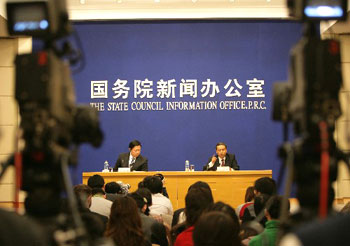
Chen Xiwen, deputy director of the Office of Central Financial Work Leading Group, briefs the press on significant historical mission of building a new socialist countryside in Beijing on Feb. 22, 2006. [Xinhua Photo] |
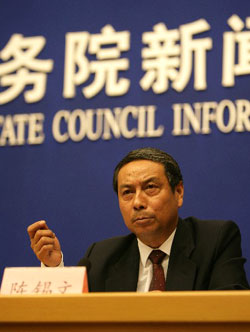
Chen Xiwen, deputy director of the Office of Central Financial Work Leading Group, briefs the press on significant historical mission of building a new socialist countryside in Beijing on Feb. 22, 2006. [Xinhua Photo] |
At the press conference sponsored by the State Council Information Office on February 22, 2006, Chen Xiwen, deputy director of the Office of Central Financial Work Leading Group, briefed the press on significant historical mission of building a new socialist countryside. He also answered questions from the press.
Full text:
Speech by Chen Xiwen, Deputy Director of the Office of Central Financial Work Leading Group
February 14, 2006
Ladies and gentlemen,
Good morning!
Yesterday, Xinhua News Agency released a policy paper entitled Opinions of the Central Committee of the Communist Party of China (CPC) and the State Council on Promoting the Building of a New Socialist Countryside published in full text. The paper is the No. 1 document of the CPC Central Committee in 2006, and the third consecutive one it has issued to guide the work regarding agriculture and rural areas since 2004. First of all, I would like to take this opportunity to brief you on some background information so that you can have a better understanding of the purpose and main contents of the document.
Why the notion was proposed?
"Building a new socialist countryside" is not a novel concept. It has frequently been referred to in the CPC and Central Government literature before. The notion was reintroduced in the Suggestions of the CPC Central Committee on the Formulation of the 11th Five-Year Guidelines on National Economic and Social Development adopted in the Fifth Plenary Session of the 16th CPC Central Committee on October 11 last year. Rather than a simple repetition of previous concepts, it has been imbued with notable relevance to the present times. Of course, it will take a long time in history for the new socialist countryside to materialize in China. Formerly meant to be a vision to pursue and a direction for development, the notion is now deemed as both a long-term goal and an urgent immediate task. The primary reason for the adjustment is that China's economic and social development have entered a new historical period when the government is more economically competent to render support to the development of agriculture and rural areas, and in a better position to coordinate the economic and social development between urban and rural areas than ever before.
Like many other countries, China needed to accumulate funds for its development from agriculture and the rural areas in the early days of industrialization and urbanization. As a result, the gap between urban and rural areas is gradually widening. At a certain stage of industrialization and urbanization, if the development strategies are not fine tuned in a timely fashion with a view to accelerating the development of agriculture and rural areas and increasing farmers' income, the overall economic and social development will be affected, and so will the program to build a well-off society in an all-round way and the modernization drive. In light of this, the concept of "building a new socialist countryside" has recently been put forward for at least the following five reasons:
First, agriculture is not a good enough foundation to meet the requirements derived from the economic and social development and the improvement of people's livelihood. In 2005, China's grain output climbed to 484 million tons, still insufficient to meet demand and nearly 30 million tons lower than the record high. The lack of farmlands and water resources constitutes a bottleneck limiting the development of agriculture. More investment should therefore be pumped into the agricultural sector so as to improve the production conditions, further the application of science and technology and increase the output of farmlands.
Second, the widening gap between urban and rural areas should be dealt with in real earnest. Since China is a populous nation with rural population making up the majority, bridging the urban-rural gap is bound to be a long process. However, top concern should be given to this process, as the gap tends to grow wider against the backdrop of accelerated industrialization and urbanization at present. The farmers' per-capita net income and the urban dwellers' disposable income were 3,255 yuan (US$402.8) and 10,439 yuan (US$1292) respectively in 2005, with the latter figure 3.22 times the former. Meanwhile, the rural-urban divide is more compelling in terms of infrastructure and social undertakings such as education, health care and culture, a drawback that greatly hinders the improvement of farmers' quality.
Third, initial conditions for industry to power agriculture and urban areas to help rural areas have emerged. China's GDP, fiscal revenue and fixed asset investment numbered 18.2 trillion yuan (US$2.25 trillion), 3.16 trillion yuan (US$391 billion) and 8.86 trillion yuan (US$1.10 trillion) respectively in 2005, compared to 8.95 trillion yuan (US$1.08 trillion), 1.34 trillion yuan (US$162 billion) and 3.3 trillion yuan (US$399 billion) respectively in 2000. These three indictors were all more than doubled during the 10th Five-Year Plan period from 2001 to 2005.
Fourth, a new socialist countryside is an essential requirement for expanding domestic demand. The farmers' low income and lack of purchasing power have in effect adversely affected the implementation of the strategy of expanding domestic consumption. Only 32.9 percent of the total retail sales of consumer products in China were realized in counties and rural areas under counties in 2005.
Fifth, it is also an essential requirement for shaping a harmonious socialist society, achieving social fairness and justice and enabling all the people to share the benefits of economic and social development.
Goals, tasks and principles of building a new rural China
The goals and tasks of building a new countryside are an all-inclusive, systematic whole. They should not be misinterpreted as merely constructing new villages. Instead, they can be summed up into the following five aspects:
--Building the countryside into areas characterized by enhanced production, well-off living standards, healthy rural culture, neat and clean villages and democratic management, as set forth in the Fifth Plenary Session of the 16th CPC Central Committee.
--Stepping up economic, political, cultural, social and Party development in a coordinated manner, as stated in the No. 1 document of the CPC Central Committee in 2006.
--Taking rural economic development as a central task; adhering steadfastly to the basic operational mechanism for rural areas enshrined in the Constitution; committing efforts to resolving the most pressing practical problems in the farmers' work and life in adherence to the people-first principle; sticking to scientific planning, taking flexible measures in line with local conditions and offering category-specific guidance; giving full play to the initiatives of all circles and relying on the farmers' hard work, the government's support and the participation of various sections of society.
--Five do's and five don'ts: Value concrete results, avoid formalistic implementation; make the most of a region's abilities, avoid competing with each other socially; adhere to democratic consultation, avoid coercion; bear distinct characteristics, avoid stereotypes; and offer guidance and support to the farmers, avoid interference.
--Five major goals: enhancing rural productivity, raising the farmers' living standards, improving rural infrastructure, boosting rural social undertakings and promoting grassroots political democracy.
Basic means of building a new rural China
The basic means is to coordinate the social and economic development between urban and rural areas in accordance with the philosophy of "scientific development." The key lies in the establishment of the following five mechanisms:
--A long-term investment (including the government's fiscal expenditure, fixed asset investment and financial funds) mechanism based on the idea of "industry rewarding agriculture and cities supporting the countryside,"
--A work mechanism featuring concerted efforts of CPC and government departments to coordinate and promote the all-round economic and social development of the rural areas,
--An incentive mechanism designed to encourage the farmers to prosper their homes by relying on their own strenuous efforts under the favorable policies of the government,
--A society participation mechanism that attracts all sections of society to render support to the campaign,
--An economic and social management mechanism aimed at phasing out urban-rural disparities. |